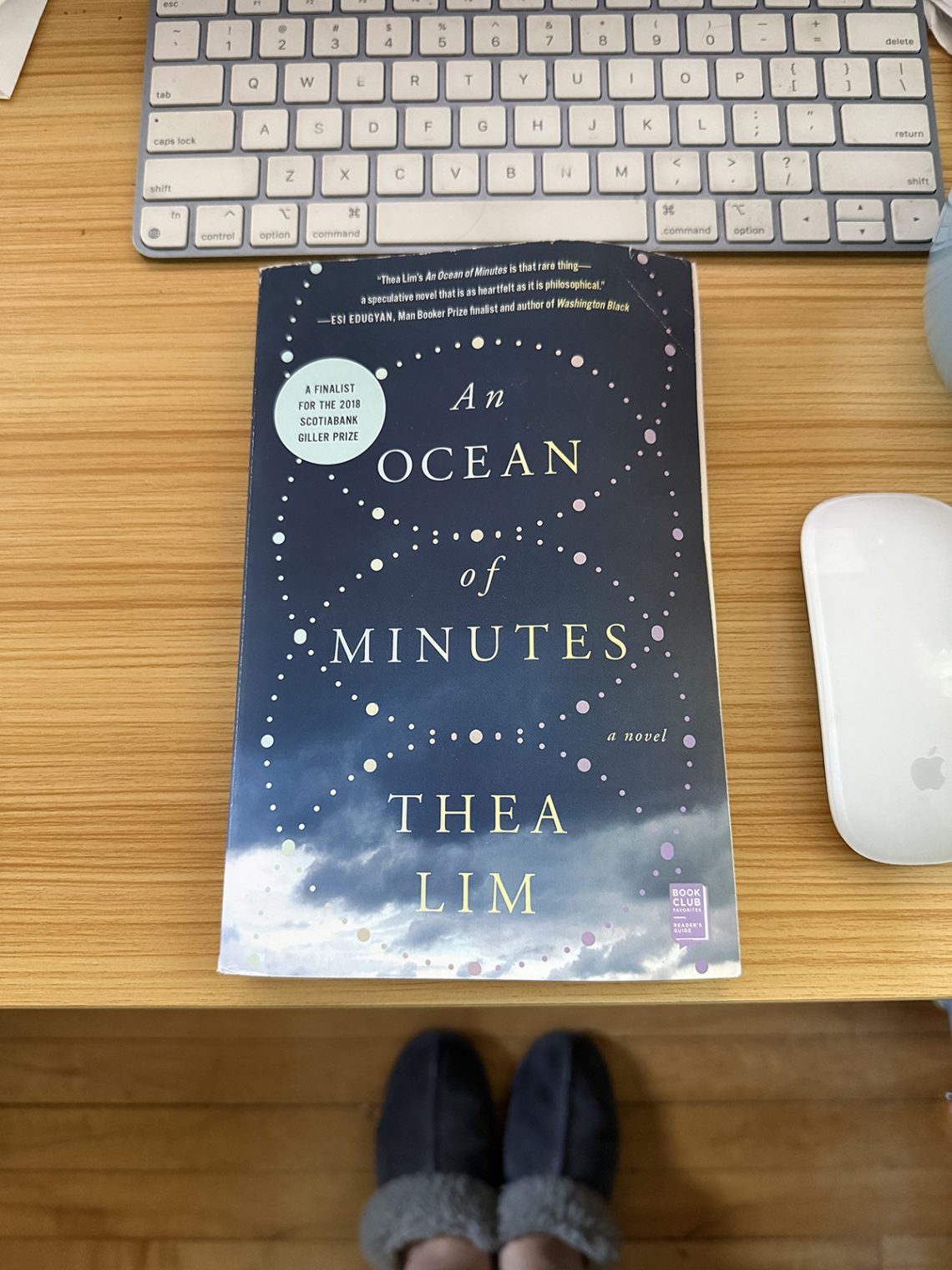
I know Thea Lim’s name like one might know the name of the classmate you sat next to in math class — the one you didn’t hang out with after school but who enjoyed talking to everyday anyway. I read her novel, An Ocean of Minutes, in a grad school class and wrote about in the discussion part of my thesis introduction. It’s dystopian, told in an alternating, nonlinear timeline. I remember reading it, so drawn to the way she constructed the story. It inspired me to use the technique in my thesis, also a novel. It has a non-linear, jumbled timeline that readers have either loved or hated, as these things go.
Reading “The Collapse of Self-Worth in the Digital Age” written by Lim and published on The Walrus was a bit like pulling back a curtain to peak behind. In her fiction, Lim is confident and strong. But she reveals the tender underbelly here, affected by other people, readers, BookScan releases. I found this so … humanizing.
I guess I didn’t think of the authors I respect as people too, though it seems ludicrous that I wouldn’t. Still: why would Thea Lim have any hangups or insecurities? Have you seen how she writes? Because she’s human after all. This makes me like her even more.
(The irony here isn’t lost on me. I, too, am a traditionally published author and very human, but I see Lim and others on a higher level of authorship than myself.)
On a deeper level, I became hyper aware of my attention span. Lim’s essay was long. While reading, I paused to check stats on an Instagram story I posted the previous night. Popups with incoming texts distracted me even as I tried not to read them. I stopped to brew a second coffee. But when I reached the end, I found myself wishing there was more. There’s clear irony in this, isn’t there?
But the advice Lim received from other authors — to keep writing — was the part that grabbed me the most. I could see myself in that line. It’s what I do. When my most recent cookbook was released, I began putting out feelers for my next project just weeks after. I haven’t found it yet, but the act of doing that made me think more about sales and interviews and how many times the cookbook popped up in my Instagram mentions. But in reality, the part I love most is the part that brings me alive — writing and creating.
Once the hype died down, I found myself writing more and more. That is how I want it to be. So the advice Lim received resonates so deeply with me.
All of this also made me think a lot about the way internet culture affects me. I received an unsolicited, massive email from a supposed publicist this morning that read like every other AI-generated ask I have received: effusive and over the top in its praise of my creativity and the importance of my work. I know they are spam, but the more I receive emails like this, the more I realize that my book is at least appearing high in search engines or whatever means the spammers are using to stalk authors.
Reading this, I found myself wishing again that another book by Lim would appear on shelves. Her writing is immersive and robust. Drawn in, I want more.
But more importantly, it was the reminder I needed. Keep writing. So I am. I will. I always will be. I am a writer. I always have been. And I will continue to be.